THE AWAKENING
FINDING MY VOICE
Joanne Marie Real | Art by Poppet
Content note:
This story contains references to serious violence, attempted murder, trauma, suicide and alcohol misuse. Some readers may find the content distressing.
Please decide whether reading further is right for you.
There are some paintings that begin with an idea. And there are others whose meaning only becomes clear while you are creating them.
The Awakening was one of those paintings.
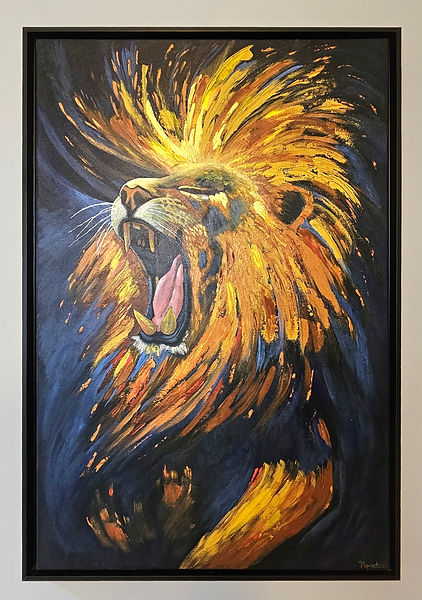
When I painted this lion, roaring out from the canvas, I began to realise that I wasn't simply painting an animal.
I was painting a voice.
And that voice was mine.
An ordinary morning
On 27 September 2006, I was a single mother with two children and a full-time career as a business development manager.
That morning should have been completely ordinary.
I had a later first appointment than usual, which meant I had the rare opportunity to take my son to school.
My phone started ringing during the journey. I knew who it was.
For more than a month, I had been subjected to repeated and distressing contact from a man I had known. I had changed my landline number, my mobile number and even my email address in an attempt to stop it.
But I hadn't told anyone what was happening. At the time, I believed I could deal with it myself and didn't understand the danger I might be in.
I didn't answer because my son was beside me. I didn't want him going into school worrying about his mum.
Once I'd dropped my son off, the phone rang again.
This time, I reluctantly answered, intending to cut the conversation short and ask him not to contact me again.
Instead, he told me that his car had broken down and asked whether, as a friend, I could give him a lift home.
I didn't want to do it. In fact, everything inside me was telling me not to.
But I agreed.
What I didn't know was that the breakdown was a ruse.
What followed was a premeditated attempt to take my life.
When your instincts are silenced
Looking back at the account I wrote in the months following the attack, one thing stands out to me now.
My instincts were screaming at me.
I noticed things that didn't make sense. I felt increasingly uneasy about his behaviour.
At one point, I stopped at a petrol station even though I didn't really need fuel.
When I went inside, part of me wanted to tell the cashier that I didn't feel safe with the man sitting in my car and ask for help.
But I didn't.
It felt like such a strange thing to say to a stranger.
I was supposed to be on my way to work and part of me was still telling myself that I shouldn't even have agreed to give him a lift, that I should just get it over with and carry on with my day.
Instead, I deliberately made conversation with the cashier.
I wanted them to look at me. I wanted them to notice me.
Somewhere inside me was the thought that if something happened to me, perhaps they would remember that I had been there.
Later, on a country lane, I deliberately made eye contact with another driver and waved.
Again, I wanted to be noticed.
I remember that he became irritated with me for doing it, which only added to the unease I was already feeling.
And yet I kept questioning myself.
During the time I had known this man, I had gradually become increasingly uneasy about aspects of his behaviour.
I had ended our relationship a few months earlier because I knew that I no longer wanted to be with him.
He had taken the end of the relationship badly, and in the weeks leading up to the attack his contact with me had become relentless.
He was highly manipulative, and during the time I had known him, he had repeatedly made me question my own judgement, whether I was mistrustful, paranoid or simply making bad decisions.
Over time, I had begun to doubt myself.
So even when my instincts were telling me that something was wrong that morning, part of me was still questioning whether I could trust them.
I had learned to doubt the very part of myself that was trying to protect me.
Eventually we reached the long country drive leading to his home.
I repeatedly asked him to get out of my car.
He wouldn't.
And then he attacked me.
The moment everything changed
I remember him suddenly launching himself at me while I was still sitting in the car, his hands around my neck.
The force was immense.
I knew I wouldn't stand a chance while I was trapped inside the car, so somehow I managed to flick the door handle open.
I fell backwards out of the car and hit the back of my head on the ground.
I was dazed and struggling to move.
But it didn't stop there.
He climbed out of the car and came after me again.
As I lay beside the car, he put his hands around my neck once more.
Until that point in the attack, I don't remember him saying a word.
I tried to fight him. I scratched at his face and tried to grab at his neck, but he had total control.
As he strangled me, I remember looking directly into his eyes.
I was trying to make some kind of connection with him, hoping that if he looked at me, really looked at me, he might realise what he was doing and stop.
But I remember seeing no emotion.
There was nothing in his expression that suggested he was going to stop.
He just kept looking from side to side, checking that no one was watching what he was doing, although we were alone in the middle of the countryside.
In that moment, I understood how determined he was to take my life.
I remember fighting. And I remember becoming weaker and weaker.
Eventually my vision began to disappear.
Darkness started at the outside edges and seemed to close in towards the centre.
I was losing consciousness.
I remember thinking that I should stop struggling and play dead.
And then something happened that I have never forgotten.
I became calm.
As the blackness closed in, I remember warm, peaceful images.
I remember sunshine and children laughing.
I felt safe.
I believed I had died.
I don't try to explain what happened in those moments, and I don't expect anyone else to interpret the experience in the same way that I do.
I can only describe what I remember and how it felt to me.
Then the images changed.
I remember people talking about my death and how devastating it would be for my children.
I have a vivid memory of what seemed to be a newspaper article about my murder.
And something inside me changed.
I couldn't leave my children.
I remember thinking:
I'm not going to die this way. My children need me.
Then I heard gasping.
At first it felt almost as though I were underwater. Everything was still black, and then my vision began to clear from the centre outwards.
I realised the gasping I could hear was my own breathing.
As I became more aware of what was happening, I realised I was no longer where I had been when I lost consciousness.
While I had been unconscious, he had dragged my dead weight from the ground and was trying to get my body into the passenger side of the car.
The passenger door was open and he was struggling to get me inside. I had no strength in my body, but somehow I managed to grab hold of the open door.
I tried to scream for help.
Help. Help. Help.
But no words would come out.
I remember holding myself up by the door because I didn't have the strength to stand. I felt completely helpless and terrified that nobody was going to hear me.
He went around to the driver's side of the car and reached across from behind me.
Then his hands were around my neck again.
This time I had almost nothing left with which to fight him. He was able to pull me down and into the car.
I lost consciousness again.
When I came round, my body was in a completely different position. My head was pushed down towards the gearbox and glove compartment, with my legs up across the passenger seat and window.
Then he began punching me repeatedly in the side of my head.
I remember something strange about those blows.
I felt no pain.
In an odd way, it almost felt as though each blow was bringing me back to life.
I also remember an overwhelming certainty coming over me that I wasn't going to die, which, given the condition I was in, made very little sense, but the feeling was incredibly strong.
I was beginning to get my bearings and could feel air returning to my lungs. I became aware that his breathing was getting faster as he continued hitting me.
I tried to reason with him.
I said anything I thought might make him stop. Anything that might keep me alive.
And then, for the first time during the attack, he spoke.
He told me to stay down and said that he had a knife.
I believed him.
My vision was still badly blurred, but from what I could make out, I became aware that what he was holding wasn't a knife.
It appeared to be a pen.
He positioned my head and seemed to be looking between my eye and my ear.
I remember being terrified that he was going to drive the pen into my eye.
Then he chose my ear.
He clenched his fist around the pen and struck down.
Instinctively, I moved.
And as I moved, I saw the passenger door handle.
Something in me told me to reach for it.
I flicked the handle.
The door opened.
My legs fell out of the passenger side of the car.
I didn't have the strength to fight him and I certainly didn't have the strength to run, but I deliberately wedged my legs down so that it would take him longer to get me back inside.
Even then, I was trying to buy myself time.
Just a few more seconds.
A few more seconds in which somebody might find me.
A few more seconds in which something might change.
He continued trying to pull me back into the car.
And then suddenly he let go.
I fell to the ground outside the car. I remember thinking afterwards that perhaps, in that split second when I felt his grip release, I had somehow helped to launch myself out.
I lay there unable to move.
My vision was badly blurred. I knew that this might be my opportunity to escape, but physically I couldn't move a muscle.
Then I became aware of him again.
He had got out of the driver's side and was coming around the car towards me.
I remember feeling terrified because I had nothing left with which to defend myself.
He grabbed me by the shoulder and started to lift me.
I couldn't fight him.
It was as though I was paralysed, and yet I was still aware of everything that was happening.
Then he let go.
I fell back to the ground.
He began walking away from me, up the drive.
My vision was still badly blurred, but I desperately tried to focus.
I became vaguely aware of a vehicle.
As he walked towards it, I managed to get onto my hands and knees.
I began begging for help.
Please help me.
Please help me.
But nobody got out of the vehicle.
Then he started walking back towards me.
For a moment, because nobody had come to help me, I actually thought the people in the vehicle might be friends of his. I thought perhaps he had called them there to help him kill me.
But as he came towards me again, something inside me told me that I had to move.
I had to run.
I somehow managed to get to my feet.
I wasn't really running. I was stumbling, falling and trying to get back up.
Then I saw him running towards me.
I knew I had to try harder.
He lunged at me again, but somehow I managed to dodge him and get past the point where I was closer to the vehicle than he was.
I climbed through a wooden fence and back onto the lane.
And this time, a man got out.
He was a farmer in a tractor.
There weren't just one but three tractors in a line.
The three farmers helped me towards the cab.
I found out afterwards that they had already called the police and had been warned not to approach because the man attacking me could be armed. I also learned that he had told them we were only play acting.
The police were already on their way.
The farmers helped me into the tractor and kept telling me to sit down.
When I finally did, I realised just how little strength I had left.
We watched as he went back to my car, turned it around and drove away.
That was the moment I finally got away from him.
But even then, I didn't feel safe.
I remember feeling as though I must be dead.
I kept asking the farmers whether they were really there.
Everything felt unreal. I felt like a ghost.
I was terrified that he would come back. In my mind, he might return with a gun and kill the farmers as well as me.
The farmers initially blocked the lane with their tractors while we waited for the police, but I was so frightened that he would return that they decided to take me to a nearby farmhouse.
Even there, surrounded by people trying to help me, I was still waiting for the danger to return.
I remember sitting on the floor, huddled in a corner.
A woman in a wheelchair came over and held out her hand to me. Then she offered to take me into another room and hug me until the police arrived.
Her kindness should have been comforting.
Instead, I was terrified.
Immediately before the attack, he had asked me for one last hug.
For a moment, that woman's offer took me straight back there.
Someone tried to reassure me by showing me through the window that there were men outside the farmhouse and that nobody was going to get past them.
But my mind couldn't believe that I was safe.
I was convinced that if he had access to a gun, he would come back and kill everyone in order to get to me.
Then the police arrived.
I felt slightly less frightened, but even as I walked towards the police car, part of me was still waiting to hear the gunshot that would end my life.
The physical attack was over.
My mind didn't know that yet.
A police search for him began immediately after the attack.
For the next 24 hours, he was not found.
I was in hospital, terrified that he might turn up.
I couldn't sleep. I sat up through the night in my hospital bed, going over every detail of what had happened, again and again, trying to make sense of the madness of it all.
I was trying to understand how an ordinary morning had ended with me lying in a hospital bed, knowing that the man who had tried to take my life was still out there.
He later took his own life.
I subsequently learned from the police that recordings had been found at his home in which he had tried to create the impression that we had intended to die together, a story that bore no resemblance whatsoever to the truth.
There were other things I learned in the aftermath that I have chosen not to include here. But there is one thing I feel is important to say.
This was not the story of a man so devastated by the end of our relationship that he tried to take both of our lives.
I was told that, at the time of his death, he had been involved with several other women.
I also learned from his brother that there had been a previous allegation involving another former partner, in which he had been accused of attempting to strangle her. I was told that the case had gone to court but had not resulted in a conviction.
His brother, whom I had never met, later asked the police if he could speak to me.
I agreed.
He was deeply upset by what his brother had done to me. He told me that he would never forgive him, and that his greatest wish for me was that I would go on, live my life and somehow put what had happened behind me.
I have never forgotten that conversation.
There would never be an arrest, a trial or a courtroom in which the man who attacked me could be held accountable for what he had done.
But I survived.
And eventually, I did go on and live my life.
Surviving was the beginning
In the days that followed, the physical reality of what had happened was impossible to escape.
I was black and blue. The left side of my face had swollen so badly that I was almost unrecognisable.
There was bruising around my neck and across my body, and my feet and toes were black with bruising, where my body had been dragged.
I also remember finding dried blood behind my ears. At one point, I carefully picked away what looked like a long, thin, almost black scab.
It brought back a conversation I'd had with a police forensic officer while I was in hospital.
He had come to photograph my injuries, and I was taken into a small, darkened room where he could examine and photograph the marks on my body.
As he photographed the tiny blood spots around my eyes and behind my ears, he suddenly stopped.
He told me that in all his years photographing people who had been strangled, he had never encountered someone with blood spots like mine who had survived. He said that, in his experience, injuries like these were usually something he saw when photographing people who had died.
I remember looking at him and saying:
"I did die."
That was how I understood what had happened to me. I remembered losing consciousness, the sensation of leaving everything behind, and then somehow finding my way back.
Hearing his words brought all of that back to me. For a moment, it felt as though he was confirming something I had experienced but couldn't fully explain.
I had suffered a broken cheekbone and a fractured skull, and I needed an operation to repair my cheekbone.
With hospital treatment and time, the swelling subsided, the bruises faded and the physical injuries gradually began to heal.
But surviving physically was only the beginning.
The injuries people could see were healing.
What happened inside me was much harder to see.
I couldn't work for twelve months.
Before the attack, I had been working full-time as a business development manager. I was independent, capable and used to supporting myself.
Suddenly, even the most ordinary things could feel overwhelming.
During that year I lived off my savings. As those savings disappeared, I began to get into debt. The attack hadn't only affected me physically and psychologically; it had changed almost every part of my life.
My employer kept my job open for me, and I will always be grateful for that. But when the time came, I couldn't go back.
I had lost so much of my confidence that I simply wasn't the person I had been before the attack.
I wasn't her anymore.
I felt like a shell.
Ordinary things became frightening.
Standing in a queue in a local shop could trigger a panic attack.
I experienced flashbacks and nightmares. Sleep became something I feared because closing my eyes meant risking being taken back there.
Even my own home no longer felt safe.
In those early weeks, I was frightened to sleep alone. My daughter, who was only fourteen at the time, would come and sleep beside me.
My mother had flown over from Spain to help me with the children. I remember one day when she had gone into town to get a few things. I became so frightened of being alone in the house that I went and stood in the garden until she returned.
I remember looking around, checking every corner. It was an enclosed garden, yet somehow I felt safer standing outside than I did inside my own home.
There were other things that were equally difficult to explain.
If I was sitting on the sofa and somebody came too close, I would suddenly feel terrified. It was as though I had an invisible boundary around me, and once somebody crossed it, my mind would take me straight back to the attack.
I would see him lunging towards me, his hands around my neck.
I knew the person beside me wasn't going to hurt me. But knowing that didn't stop the fear or the flashbacks.
That was one of the hardest things about PTSD. I could understand logically that I was safe, but I couldn't make myself feel safe.
I also remember that first Christmas after the attack.
Everyone around me was preparing for a time that was supposed to be happy and full of celebration. But inside, I was struggling more than I knew how to express.
It became one of my darkest periods. I felt so overwhelmed by what was happening in my mind that, at one point, I began to think I would be better off not being here.
I couldn't see how I could carry on feeling the way I did. The world had changed. It was now a dark, frightening place.
I felt like a wounded animal, frightened, in pain, and constantly on guard against a danger I could no longer see.
I was simply trying to get through each day.
So I found another way of switching everything off.
Alcohol.
At first, alcohol seemed to give me what I desperately wanted. If I drank enough, I could sleep.
But the relief was temporary.
The following day the anxiety was worse.
The flashbacks were worse. The nightmares were worse.
And because everything felt worse, I wanted to drink again.
It became a cycle.
I wasn't drinking for pleasure.
I was trying not to feel.
Learning to trust again
Eventually, I sought professional help.
That presented another challenge I hadn't anticipated.
The man who had tried to kill me had been a psychotherapist.
The thought of placing myself in a room with another therapist and allowing that person access to the most vulnerable parts of me frightened me enormously.
I asked for a female therapist.
The waiting list was long and eventually I was offered a male therapist.
I was extremely anxious about accepting.
But I did.
And that man helped change my life.
Recovery wasn't a miraculous conversation in a therapy room. It was gradual, uncomfortable and sometimes frightening.
As part of my therapy, I returned to the place where I had been attacked.
It took around four separate attempts before I was able to face it.
But eventually I did.
My therapist helped me understand what was happening inside me and gave me tools to manage emotions that, until then, had felt completely beyond my control.
Slowly, I began reclaiming pieces of myself.
In 2012, I stopped drinking completely.
I have never drunk alcohol since.
Over time, I began to reclaim my confidence, my independence and the life I had once known.
I went on to live a full life, doing things that at one time I could barely have imagined being capable of again.
Today, I consider myself healed from PTSD.
That doesn't mean I've forgotten what happened.
For a long time, I thought what had happened to me would define the rest of my life.
But it didn't.
What happened to me will always be part of my story, but it doesn't define who I am.
And I feel strongly that people who have experienced severe trauma should know that recovery is possible.
It may look different for everyone, and it can take time, but the way you feel in the darkest moments doesn't necessarily have to be the way you feel for the rest of your life.
The things the body remembers
Nearly twenty years later, there are still things that can take me back.
Sometimes it's something completely unexpected.
A smell.
A place.
A sensation.
The countryside can contain reminders because that was where the attack happened.
Even the smell of cattle can trigger a memory because of where I was lying that day.
But a trigger today is not what it once was.
A memory can be a memory.
It doesn't have to become my present.
That distinction took me years to learn.
The secret I carried
For a very long time, I rarely spoke about what had happened.
People I worked with later in life often knew nothing about this part of my history. Many people who came into my life afterwards had no idea at all.
I carried it almost like a dirty little secret.
For a long time, I felt deeply ashamed of what had happened to me.
Logically, I knew that I had done nothing to be ashamed of. I had been the victim of a violent crime. But trauma doesn't always respond to logic.
I had never imagined that something like this could happen to me. Suddenly I found myself trying to understand not only what had happened, but what it meant to be someone to whom this had happened.
At the time, I also felt there was an unspoken expectation that these were things you didn't talk about. You survived, you picked yourself up, you put it behind you and you got on with your life.
And that is what I tried to do.
I put it away.
I rebuilt my life.
I carried on.
From the outside, I think I became very good at doing exactly that.
But silence can become its own kind of burden.
The longer I didn't talk about what had happened, the harder it became to talk about it. Something that had been done to me gradually became something I felt I had to hide.
For many years, I thought putting it away was strength.
Today, I see it differently.
I don't believe there is anything shameful about having survived violence. I don't believe what somebody did to me says anything about who I am.
And I no longer feel that protecting myself means keeping this part of my life hidden.
For many years, silence was enough.
Until painting found me.
Painting through grief
In 2025, after losing my father, I began painting seriously.
What started as something creative quickly became something much more important.
Painting became my solace.
I painted and painted.
For around six months, I threw myself into creating work.
One night, very late, I was sitting in my front room, where I used to paint before I had my own studio.
My husband had gone to bed, and I was putting the final strokes onto The Awakening with my painting spatula.
I remember stopping and looking at the lion.
And suddenly, I began to cry.
I realised that for almost six months, since losing my father, I had thrown myself into painting without really allowing myself to grieve.
But as I sat there looking at this roaring lion, my thoughts also went back to the years following the attack. I remembered the woman I had been then, how frightened and vulnerable I had felt, and how much of myself I had lost.
And yet, looking at the painting, I didn't feel that same weakness.
I felt strength.
I had felt such a strong desire to paint a roaring lion, without really understanding why. And now, with the painting almost finished in front of me, I began to understand.
It wasn't simply about the lion.
It was about everything I had survived, everything I had worked so hard to overcome, and finally finding the confidence to be heard again.
That night, I understood what The Awakening meant to me.
It was about finding my voice.
Without consciously deciding to, I had found another way of processing something that felt too big to hold.
But this time it wasn't alcohol.
It was colour.
Canvas.
Light.
And paint.
And it was there, in those final moments of painting The Awakening, that I understood just how much this roaring lion meant to me.
The lion
When I look at this painting, I don't see an angry lion.
I see a voice.
I see the woman who couldn't speak while hands were around her throat.
I see the woman who afterwards became frightened of being seen and frightened of being heard.
I see the woman who tried to silence memories with alcohol.
I see the woman who walked back into the place where she had almost lost her life because she wanted to take something back from it.
And I see the woman standing here today.
For years, I thought strength meant putting what happened away and getting on with life.
I don't believe that anymore.
For me, strength has also been learning that I can look back.
I can talk about what happened.
I can acknowledge the person I was then without becoming her again.
And I don't have to be ashamed of any part of my story.
The Awakening
Perhaps that's why this painting came when it did.
Nearly twenty years after I almost lost my life, and during another period of loss, something that had been quiet for a very long time found its way onto a canvas.
A lion.
Mouth open.
Unapologetically present.
A voice that cannot be silenced.
The Awakening isn't a painting about the man who attacked me.
I don't want it to be.
It's about what came afterwards.
It's about survival, recovery and the extraordinary ability we have to become something more than the worst thing that has happened to us.
Most of all, it is about finding your voice after believing for a very long time that you had lost it.
And perhaps that is what this painting means to me more than anything else.
I am no longer the frightened woman I once was.
I have found my strength.
And I have found my voice.
A note about this account
In October 2006, shortly after the attack, I wrote down in my own words everything I could remember about what had happened to me.
At the time, putting it onto paper was my way of trying to process the events and make sense of something that felt impossible to understand.
The account you have read here draws directly from what I wrote at that time. I have edited and condensed parts of the original account for this piece, but the events, memories and experiences described are taken from my own recollection as I recorded it in the weeks following the attack.
Joanne Marie Real | Art by Poppet
If you would like to follow my continuing journey as an artist and see the paintings as they emerge, you can find me on Instagram at @artbypoppet.